Project Info
Project Description
Metamorphoses
… homage à M. C. Escher
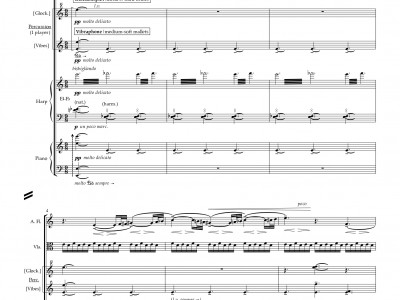
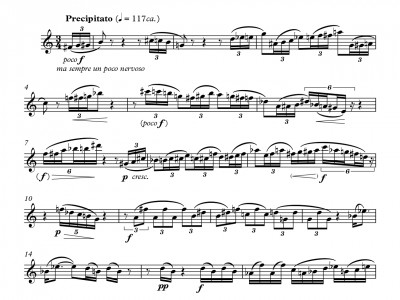
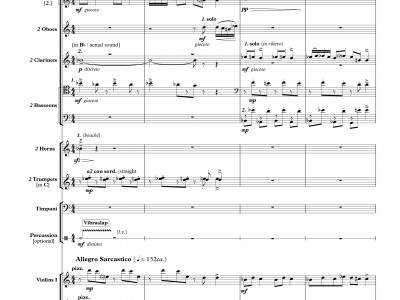
for chamber orchestra: *2*2*2*2-2200-timp.+1perc.-strings (min. 6.5.4.4.2 | max. 12.10.8.6.4)
- composition date: 2009/rev. 2010
- duration: ca. 11 min.
- detailed orchestration:
2fl. (2+picc.)/ 2ob. (2+eng.-horn)/ 2cl. (2+bass-cl.)/ 2fg. (2+contra-fg.)/ 2hr./ 2trpt./ timp./ perc.(1): 3 susp. cymb. [large/medium/small]; sizzle cymb.; 2 triang. [small/big]; tambourine [big]; very high bongo; wind chimes [mark-tree]; glockenspiel; vibraphone/ strings (min.: 6 vl.I / 5 vl.II / 4 vla. /
4 vlc. / 2 cb. || max.: 12 vl.I / 10 vl.II / 8 vla. / 6 vlc. / 4 cb.) - premiere: 24/July/2009 | Auditório Municipal da Póvoa de Varzim | Orquestra Sinfónica da Póvoa de Varzim/ dir. Pedro Amaral
- Award-winning piece: 2nd Prize at the 4th Póvoa de Varzim International Composition Competition (2009), organized by the Póvoa de Varzim International Music Festival (Portugal).
The graphic universe of Maurits Cornelius Escher (1898–1972, better known as M. C. Escher) has always exerted a profound and lasting fascination on me, due to the way it reconciles a fantastic imagination with almost mathematical technical rigour. In particular, his celebrated sequences Metamorphosis I, II, and III present a world where the clarity of visual discourse emerges from an absolute intrinsic perfectionism, resulting in a plastic continuum where distinct – and sometimes seemingly irreconcilable – forms merge and transform seamlessly.
In this orchestral tribute to the great Dutch printmaker, the concept of “metamorphosis” is transposed to the musical domain through the technique of continuous variation. The work is structured as a succession of interconnected sections – Escher’s various “worlds” – which share a common germinal idea. Recurring melodic motifs, rhythmic cells, and harmonic fields function like Escher’s polygons: elements that, when manipulated, give rise to new figures without ever losing their original genetic matrix.
Invoking the aphorism ma fin est mon commencement, and just as Escher returns to the initial image after countless “metamorphoses”, my composition proposes a linear and organic journey that eventually returns to its starting point. Here, the process of variation is not an end in itself, but the engine for a sensory experience that seeks to reflect the fluidity of the Dutchman’s engravings. The ultimate goal is communication with the listener, inviting them to traverse a sound architecture as intriguing and captivating as Escher’s impossible geometries.
May/2009
(rev. June/2009)
buy sheet music / rental materials:
https://editions-ava.com/produto/metamorphoses-homage-a-m-c-escher/
multimedia:
[available soon]