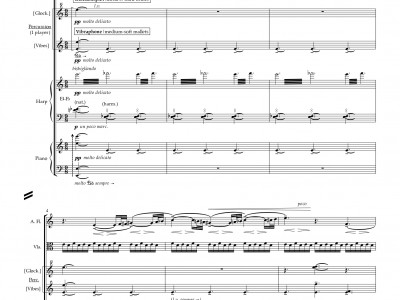
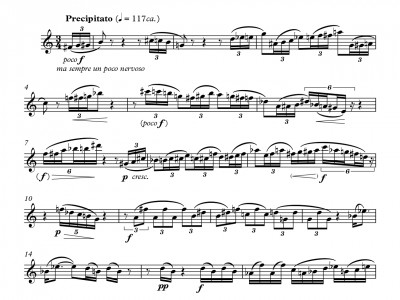
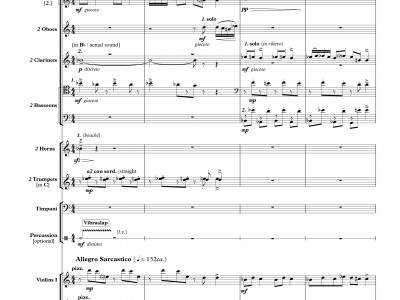
Project Info
Project Description
Nise Lacrimosa
Romance for orchestra
for chamber orchestra: *º2*2*22 – 2200 – 1perc. – strings
- composition date: 2010/ rev. 2011/ new rev. 2017
- latest version: corr. & rev. 2022
- duration: ca. 11 min.
- dedication: «for Alexandre Delgado, in deepest friendship»
- detailed orchestration:
2fl. (1+picc./2+alto-fl.)/ 2ob. (2+eng.-horn)/ 2cl. (2+bass-cl.)/ 2fg./ 2hr./ 2trpt./ perc.(1): timpani; 2 susp. cymb. [large/small]; 2 triangles (suspended) [small/big]; wind chimes [mark-tree]; slapstick; glockenspiel/ strings (min. 6.6.4.4.2 | max. 9.9.6.6.4) - premiere: 4/July/2011 | Alcobaça, Cine-Teatro João D’Oliva Monteiro | Portuguese Chamber Orchestra/ dir. Pedro Carneiro
- commissioned by Cistermúsica 2011–XIX Alcobaça Music Festival
- nominated for the Authors Prize 2012, held by SPA [Portuguese Authors Society] and RTP [Portuguese Broadcasting Corporation]
The episode of the Loves of Pedro and Inês, concerning the romance between the then crown prince and future king Peter I of Portugal and the Galician noblewoman Inês de Castro, is undoubtedly one of the most haunting moments in the Portuguese collective memory. Passion, intrigue, hatred, death, and vengeance are but a few elements of what could easily be a genuine romantic novel, were it not for the harsh reality of being based on true facts. Indeed, this historical episode is so rich in drama that numerous artists have explored it—from painters to writers and, naturally, composers, particularly within the operatic genre.
However, the perspective of my orchestral work, NISE LACRIMOSA, is not, nor does it intend to be, descriptive stricto sensu. Just as a contemporary painter would most likely not produce a realistic, period-accurate representation of those events, my music (although definitively inspired by the story of Pedro and Inês) adopts a more subjective approach, perhaps closer to the style of a surrealist painting. The various elements are present and perceptible, yet they are not necessarily “aligned” within a traditional narrative.
Above all, I seek to convey emotions through my music rather than facts: the emotions that I imagine swept through the souls of the two lovers at that time, or those of King Alfonso IV, Pedro’s father, when courtly intrigues persuaded him to order the murder of Inês de Castro, as well as those of the assassins who perpetrated such an ignoble act. Ultimately, it also reflects my own emotions while pondering the events of this tragic story. I do not deny that I write music which I hope appeals to the listener, but not necessarily by being “beautiful” in a vague and aesthetically superficial sense; rather, it aims to transmit those precise emotions that, in my view, constitute the very core of Art in its broadest sense.
Finally, I borrowed the title, NISE LACRIMOSA, from a work by the 16th-century Spanish playwright Jerónimo Bermúdez. Under the pseudonym António Silva, Bermúdez actually wrote two plays on this subject, Nise lastimosa (or lacrimosa, depending on the sources) and Nise laureada, both from 1577. These were, in turn, based on the 1558 work A Castro (or Tragédia de Inês de Castro) by António Ferreira (1528–1569), one of the greatest Portuguese writers and humanists of the Renaissance. As previously mentioned, my musical work is not descriptive, so there is no parallelism between it and Bermúdez’s literary piece. I merely appropriated the title because I find the combination of the two words, in a purely phonetic sense, highly compelling: simultaneously sweet [Nise] and sorrowful [Lacrimosa].
April 2011
(rev. July 2022)
buy sheet music / rental materials:
https://editions-ava.com/produto/nise-lacrimosa/
multimedia: