Project Info
Project Description
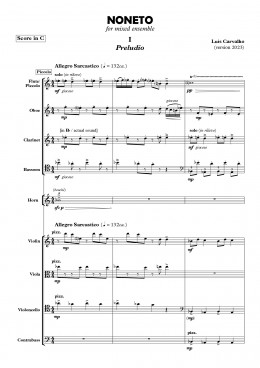
Nonet
for mixed ensemble: *1.*1.1.1 – 1.0.0.0 – strings (1.0.1.1.1)
- composition date: 2023
- detailed instrumentation: Flute (+Piccolo) / Oboe (+English Horn) / Clarinet (Bb+A) /
Bassoon / Horn / Violin / Viola / Violoncello / Double bass - duration: ca. 17:00 min. (2’+4’30”+5’+2’+3’30”)
- movements:
I – Preludio
II – Barcarola
III – Lamento
IV – Humoresque (intermezzo)
V – Finale
- premiere: [not yet premiered]
Nonet (2023), for mixed ensemble (flute, oboe, clarinet, bassoon, horn, violin, viola, cello, and double bass), represents the third incarnation of the musical material originally conceived for the Quartet (1992–93), which I composed for four clarinets and later revised and reworked in the Quintet (1997–98), for five winds (a classical wind quintet: flute, oboe, clarinet, bassoon, and horn).
The original clarinet piece is structured in three movements—Prelude, Lament, and Finale—following a conventional fast-slow-fast tripartite form. These movements are retained in the later versions, albeit profoundly reworked and, in some cases, expanded with the addition of new material, even though the original thematic ideas remain largely intact.
With each new version of the piece, however, I also added an entirely new and exclusive movement, thus progressively extending and diversifying the formal architecture. For the Quintet, I composed Humoresque, an intermezzo placed third (between Lament and Finale) in the newly established four-movement structure. In the present Nonet, it is the Barcarolle that comes to life, now interposed between the opening Prelude and Lament, resulting in a five-movement formal design: Prelude, Barcarolle, Lament, Humoresque, and Finale.
I also sought to create interconnections between the new and pre-existing movements, incorporating small quotations and cross-references to motives and themes from earlier sections into the new material, thereby striving for a more cohesive overall musical organicity.
The style is unapologetically neoclassical, and the musical discourse is relatively straightforward and unpretentious, despite the use of modern, atonal language. This is a work that has accompanied me since my student days at the Porto Conservatory of Music, and although each new version has aimed to refine and renew the development of the musical material, I have also wished to preserve a certain original purity in the ideas of the adolescent composer I once was when writing the initial Quartet—a past I do not disown.
With each new version, the instrumental forces were likewise expanded, bringing greater timbral variety to the work. This, too, enriched the musical discourse, making it more fruitful and engaging, in a process of ongoing artistic renewal that has allowed me to revisit my own past with fresh eyes and new perspectives.
buy sheet music:
[available soon]
multimedia:
[available soon]